


The webmaster is the person responsible for everything related to a website. At least if the website is small and does not require a whole staff. Moreover, the owner of the website is often his own webmaster. That means he has to do his own maintenance, development and promotion of the website. That is, be an administrator, programmer, interface designer, content creator and even a technical support staff member. And this is not an easy task. Especially considering that the website also needs constant monitoring for emerging problems and errors.

Basic webmaster routines
All and all, every webmaster must know the basics of maintaining a website. Otherwise it’s impossible to do the job. Thus it’s important to learn some basic knowledge before trying to become a webmaster.
Website index file or Robots.txt
The first of the vital parts of a website that webmasters should work with is Robots.txt . No one can easily remember why it's called that, but every website has a UTF-8 index file named Robots.txt in its structure. This file is intended for search engine analyzers that index pages on a website. It provides recommendations on which pages and files should be analyzed and indexed. To check its integrity and configuration, every webmaster can easily use Google services.
Website meta-tag system
Another important thing to know how to work with is meta tags. Generally speaking, meta tags are lines of code of a web page intended for automatic search engine analyzers. These lines inform search engines about the topic of a particular web page. This is vital for every publicly accessible website, especially those related to business. After all, properly compiled and configured meta tags can significantly improve the website's position in search results and advertising of various services.
Website server maintenance
The existence of a website is impossible without understanding the features of web servers. The webmaster needs to understand how these servers handle HTTP requests from users, how they respond, etc. Apache is the most popular web server today. It hosts 2/3 of the websites around the world. Nginx, Lighttpd and IIS servers are also in demand, but are currently less popular.
Database Management System
The full-fledged operation of the website involves the use of a DBMS in which all the accumulated information will be stored. The most common database management system is MySQL. This database is supported by all modern CMS services. It should also be added that when studying the capabilities of the DBMS, the webmaster must master one of the server programming languages (PHP, Python, Perl, etc.). This will be an almost vital requirement for webmasters in terms of the convenience of managing the DBMS service.
Stable website hosting importance and parameters
Web hosting is literally a place to host internet projects on physical and virtual servers connected to the Internet to ensure that websites are always present on the internet. As a rule, this is a service that will ensure the presence of your Internet resources on the Internet for the period for which you ordered and paid for this service. So, the first important conclusion: if you decide to create and launch a website on the Internet, it will need hosting.
Whenever someone enters the name of a website into the browser's address bar, the host sends all the data necessary to process the request: texts, images, files, and so on. And if the server does not cope with its task, the user simply will not be able to use the resource. Because it will be slow or unavailable. And sometimes you can even lose an Internet resource.

Considering all of the above, reliable hosting is very important, since the servers allocated for it work without interruptions. Good hosting ensures the smooth operation of your content, allows you to provide your visitors with a great experience and attracts more and more new people to your website.
When choosing the web hosting, base it on your needs and try to anticipate the future. That's needed in order to avoid possible problems in the process. Budget hosting providers usually focus exclusively on providing shared hosting services. Which means that when your project needs more resources and you are ready to switch to a VPS or even rent a dedicated server, you will have to change hosting. So choose hosting with the future in mind.
Website monitoring importance and useful tools for it
The term "website monitoring" refers to any activity that checks the availability, performance and functionality of a website or web server. Thus, there are three parts of complex website monitoring procedures.
Uptime monitoring literally ensures that the website is always available and functioning. Availability can include web services, domains, and pages. If your customers visit your website frequently, you need a high level of uptime. So that your customers are satisfied and receive the information or services they need. If the problem of downtime remains unresolved for a long period, then most likely your customers can switch to one of your competitors.
Performance monitoring is necessary to check the loading speed of the website. The performance check tracks the speed of incoming and outgoing connections and the loading time of a web page in the browser. Full page validation collects performance data for each page element, displaying warnings about errors, missing content, and poor performance.
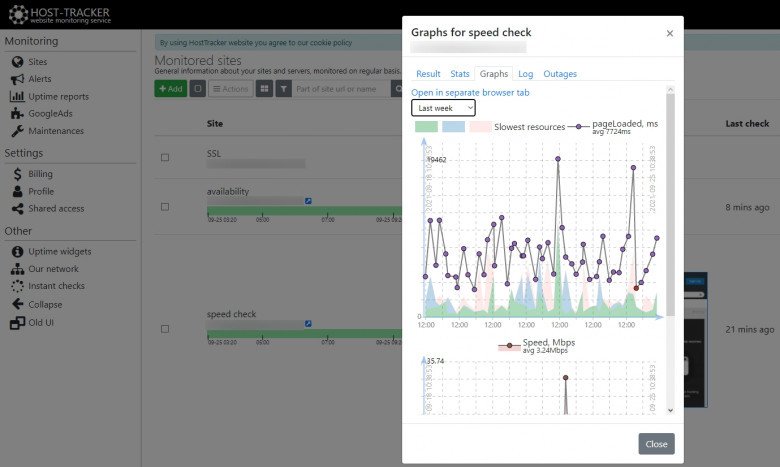
Website functionality monitoring is a series of tests aimed at checking the script files responsible for the operation of the active elements of the website. In case of an error or a decrease in performance, the system issues an appropriate warning.
Effective website monitoring tools
Monitoring a website 24/7 is very important for maintaining a website. After all, sometimes even a seemingly minor problem with the stability or availability of a website can cause a lot of problems. And if you are the owner of the website or its webmaster, these problems will become your own headache.
Thus, round-the-clock monitoring will allow you to avoid these problems so that visitors to your website can use it without problems. However, daily manual monitoring of a website takes a lot of time. And in order to free it, the webmaster should use a useful automated service.
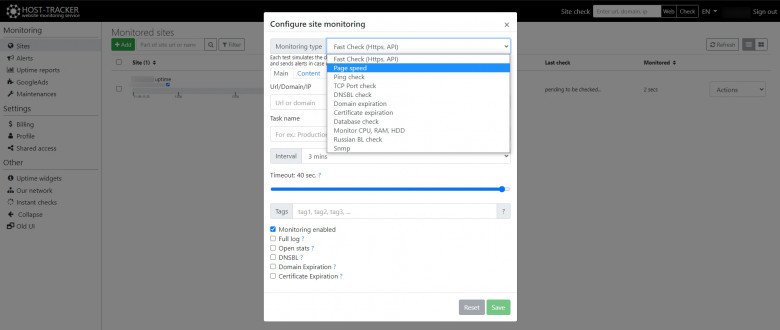
And all you need to provide a complex monitoring to your website is a HostTracker website monitoring platform. You will be able to find out not only that the website has stopped working, but also when and why. Moreover, you will be able to track when it started loading slowly, creating inconvenience for customers. The company saves you money and time because problems are diagnosed and fixed faster, which means less downtime.