

COVID-19 Impact Analysis on Global Smart Card In Healthcare Market
The COVID-19 pandemic has had a significant impact on the global smart card in healthcare Market industry. Smart cards have been widely used in the healthcare sector for years, providing secure and easy access to patient data, tracking medical procedures, and ensuring the integrity of health records. However, the pandemic has highlighted the need for even more advanced technologies in the healthcare sector, as the demand for telemedicine, remote patient monitoring, and other digital health solutions has skyrocketed.
One of the biggest impacts of the pandemic on the smart card in healthcare industry has been the acceleration of digital transformation in healthcare systems. Healthcare providers have been forced to adopt new technologies and tools to keep pace with the rapidly evolving healthcare landscape, and smart cards have played a critical role in this process. Smart cards have helped healthcare providers to securely store and share patient data, access electronic health records, and provide remote patient care.
Another key impact of the pandemic has been the increased demand for contactless payment and identification systems. Smart cards have been widely used in contactless payment systems, and this technology has proven to be especially useful during the pandemic, as it minimizes the risk of transmission of the virus. Similarly, smart cards have been used for contactless identification and access control, helping to ensure the safety and security of healthcare workers and patients.
The pandemic has also highlighted the need for increased cybersecurity measures in healthcare systems. As healthcare providers have increasingly relied on digital technologies and smart card systems to provide care, the risk of cyber attacks and data breaches has also increased. Healthcare organizations have had to invest heavily in cybersecurity measures to protect patient data and ensure the integrity of healthcare systems.
Overall, the COVID-19 pandemic has accelerated the adoption of smart card technology in healthcare systems, as healthcare providers have had to quickly adapt to new challenges and changing patient needs. Smart cards have played a critical role in ensuring the safety, security, and continuity of healthcare services, and this trend is likely to continue in the post-pandemic world.
MARKET DRIVERS
The global smart card in healthcare market is being driven by a number of factors, including:
· Increasing demand for digital health solutions: With the growing prevalence of chronic diseases and an aging population, there is a growing demand for digital health solutions that can help healthcare providers to deliver more personalized, efficient, and effective care. Smart cards provide a secure and efficient way to store and share patient data, which can be used to inform treatment decisions and improve outcomes.
· Government initiatives: Governments around the world are investing in healthcare IT infrastructure and initiatives aimed at improving patient care and reducing costs. Many governments are promoting the adoption of electronic health records (EHRs) and other digital health technologies, which are driving the adoption of smart card technology in healthcare.
· Need for secure patient data: The healthcare industry is highly regulated and requires strict privacy and security measures to protect patient data. Smart cards provide a secure and efficient way to store and transmit patient data, ensuring that sensitive information is protected from unauthorized access and cyber threats.
· Rising healthcare costs: Healthcare costs are rising globally, and healthcare providers are under pressure to reduce costs while improving patient outcomes. Smart cards can help healthcare providers to streamline administrative processes, reduce errors, and improve efficiency, which can lead to cost savings.
· Increasing focus on patient engagement: Patients are becoming more involved in their own healthcare and are demanding greater transparency and access to their medical records. Smart cards can provide patients with secure and convenient access to their medical records, allowing them to better manage their own health and participate in treatment decisions.
Overall, the increasing demand for digital health solutions, government initiatives, the need for secure patient data, rising healthcare costs, and increasing focus on patient engagement are all driving the growth of the smart card in healthcare market.
Get Free Sample Research Copy for More Industry Insights:
https://www.axiommrc.com/request-for-sample/11277-smart-card-in-healthcare-market-report
MARKET OPPORTUNITY
The smart card in healthcare market offers several opportunities for growth and development, including:
Increasing adoption of telemedicine: The COVID-19 pandemic has accelerated the adoption of telemedicine, and this trend is expected to continue in the post-pandemic world. Smart cards can be used to securely store and transmit patient data during telemedicine consultations, enabling healthcare providers to provide high-quality care remotely.
Growing demand for patient identification and access control: Patient identification and access control are critical components of healthcare delivery, and smart cards offer a secure and convenient way to manage these processes. As healthcare providers increasingly rely on digital technologies, smart cards can provide a reliable and efficient means of identifying and managing patient access to healthcare services.
Expansion of healthcare IT infrastructure: The global healthcare IT infrastructure is expected to continue to expand, driven by government initiatives, rising healthcare costs, and the need to improve patient outcomes. Smart cards can play a critical role in this expansion by providing a secure and efficient means of storing and transmitting patient data.
Increasing focus on population health management: Population health management is becoming increasingly important as healthcare providers seek to improve outcomes and reduce costs. Smart cards can provide a valuable tool for population health management by enabling healthcare providers to collect, store, and analyze patient data to identify trends, improve care coordination, and prevent disease.
Advancements in technology: Smart card technology is continuing to evolve, with advancements in biometric identification, wireless communication, and data encryption. These advancements are expected to drive innovation in the smart card in healthcare market, enabling healthcare providers to deliver more personalized, efficient, and effective care.
Overall, the smart card in healthcare market offers significant opportunities for growth and development, driven by the increasing adoption of telemedicine, growing demand for patient identification and access control, expansion of healthcare IT infrastructure, increasing focus on population health management, and advancements in technology.
MARKET RESTRAINTS
The smart card in healthcare market also faces several restraints that may hinder its growth and development, including:
· High implementation costs: The implementation of smart card technology can be expensive, especially for small healthcare providers. This can make it difficult for some healthcare providers to adopt smart card technology, limiting the market's growth potential.
Data security concerns: Smart cards store sensitive patient data, and there are concerns about the security of this data. As healthcare providers increasingly rely on digital technologies, the risk of cyber-attacks and data breaches is also increasing. This can create a barrier to adoption for some healthcare providers who are concerned about the security of patient data.
Lack of interoperability: Smart card technology may not be interoperable with all healthcare systems, making it difficult for healthcare providers to share patient data across different systems. This can limit the effectiveness of smart card technology in improving patient outcomes and reducing healthcare costs.
Limited awareness and education: Many healthcare providers may not be aware of the benefits of smart card technology or may not have the necessary education and training to effectively use smart card technology. This can limit the adoption of smart card technology in healthcare.
Resistance to change: Some healthcare providers may be resistant to change and may prefer traditional paper-based systems for managing patient data. This can make it difficult to convince these providers to adopt smart card technology.
Overall, the high implementation costs, data security concerns, lack of interoperability, limited awareness and education, and resistance to change are all factors that may restrain the growth and development of the smart card in healthcare market.
MARKET GROWTH CHALLENGES
The smart card in healthcare market has seen significant growth in recent years, as more healthcare providers and organizations adopt smart card technology to improve patient care and data security. However, there are also several challenges facing the growth of this market:
· High initial investment: Implementing smart card technology can be expensive, especially for smaller healthcare organizations or developing countries. This can be a major barrier to entry for organizations that may not have the financial resources to invest in such technology.
· Lack of standardization: Smart card technology is still relatively new in the healthcare industry, and there is currently no universal standard for how smart cards should be used or implemented. This can create confusion and make it difficult for organizations to choose the best solution for their needs.
· Resistance to change: Implementing new technology can be a difficult process, and there may be resistance from healthcare providers who are comfortable with existing systems or may not fully understand the benefits of smart card technology.
· Security concerns: While smart cards are designed to improve data security, there is always a risk of security breaches or hacking. Healthcare organizations need to ensure that their smart card systems are secure and that patient data is protected.
· Limited interoperability: Smart card systems may not be fully interoperable with other healthcare systems or devices, which can limit their usefulness and effectiveness in certain situations.
Overall, while the growth of the smart card in healthcare market is promising, there are still several challenges that need to be addressed in order to ensure widespread adoption and success.
MARKET SEGMENTATION OVERVIEW
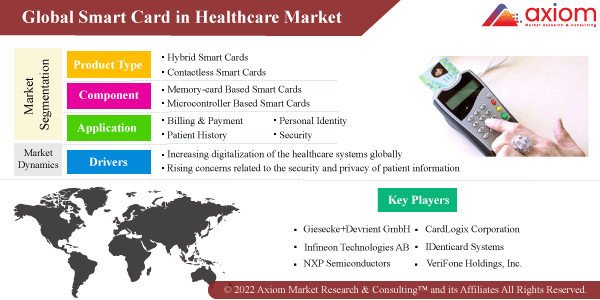
The global smart card in healthcare market comprises of different market segment like product type, component, application and geography.
· Smart Card In Healthcare Market by Product Type
· Smart Card In Healthcare Market by Component
· Smart Card In Healthcare Market by Application
· Smart Card In Healthcare Market by Geography
Buy Now And Get More Discount:
https://www.axiommrc.com/buy_now/11277-smart-card-in-healthcare-market-report
MARKET KEY PLAYERS
· Giesecke+Devrient GmbH
· Atos Se
· Infineon Technologies AB
· NXP Semiconductors
· Texas Instruments Incorporated
· Thales Group
· CardLogix Corporation
· IDenticard Systems
· American Express Company
· Gemalto NV
· INSIDE Secure SA
· Oberthur Technologies SA
· VeriFone Holdings,
· SCM Microsystems
Contact Us:
Axiom Market Research & Consulting™
3 Germay Dr. Ste 4 - 4666
Wilmington DE 19804
U.S.:- + 1 (845) 875-9786
U.K.:- + 44 (0) 20 3286 9707
Email: sales@axiommrc.com
Website: https://www.axiommrc.com/
http://contactsnleads.com/
Blog: https://industrywatch24.com/
https://readbeyondnews.com/
Follow On
LinkedIn: https://www.linkedin.com/company/axiom-market-research-and-consulting/
Twitter: https://twitter.com/AxiommrcCom
Instagram: https://www.instagram.com/axiom_mrc
Facebook: https://www.facebook.com/axiommrc